What does the rice purity test score mean? If you’ve recently completed the Rice Purity Test, then you’ve looked at your final result for a few seconds and then wondered about what it means for you. There are plenty of score charts, memes, and discussions on the internet, but few people really understand the rice purity test score meaning beyond just the numbers.
The test was built by Rice University students for a “social experiment” to enable people to compare their lives. It eventually morphed into a teeny-pop phenomenon that got adopted by curious teens, college students, and even adults to see exactly where they stand on the 100-point rice purity scale in terms of how “experienced” or “innocent” they look.
The important thing to remember is that the rice purity test score meaning your score is NOT what makes you who you are, smart or stupid, or valuable or worthless. Rather, it’s a compilation of life experiences, choices, and social situations. There are no right or wrong answers; some people get high scores because they are more reserved, others get lower scores because they have had more experience in various aspects of life at an earlier age.
We’ll discuss the actual rice purity test score meaning, the complete system, what each range generally means, and the psychology and social curiosity that permeates the very act of taking the test.
Rice Purity Test: What is it?
The Rice Purity Test is a questionnaire made up of 100 yes-or-no questions related to:
- Relationships
- Social experiences
- Rule-breaking
- Romance
- Alcohol and parties
- Personal behavior
- Adult experiences
Rice purity score meaning justifies that each player begins on 100 points and loses points for each experience that they have had. The lower the score, the more experiences are considered by someone.
When people find the rice purity test score meaning they think there is a good or bad score. The test is actually more of a curiosity and entertainment divertissement than a personality evaluation.
Understanding the Rice Purity Scale
The rice purity score chart is a reversed scale from other scales. The higher the number, the lower the number of experiences and vice versa.
A general overview of the score interpretation:
- 10-20: Normal or low
- 21-30: Borderline
- 70-80: Very innocent or few life experiences
- 70-89: Fairly typical of younger teens or reserved individuals
- 50-69: Average
- 30-49: Very skilled at social and adult activities
- 30 or below: Very experienced in lifestyle, more exposure to that area
This score interpretation is not scientific. It’s just a normal trend seen on the web when individuals share their outcomes.
What Does a High Score Mean?
People with scores above 90 are considered very innocent or inexperienced in romantic and social issues. But that doesn’t always imply they are still young and sheltered.
A high score could mean:
- Strong personal values
- Cultural or religious boundaries:
- Engage in academics or career.
- Limited social exposure
For those students who get higher rice purity test scores, the rice purity test meaning is typically associated with caution, privacy, or a slower rate of pursuing relationships and social events.
What Does an Average Score Mean?
The range of rice purity test scores is considered to be socially normal and balanced.
The average score indicates that:
- Some relationship experience
- Moderate social exposure
- Some rule-breaking/experiments
- Balanced personal boundaries
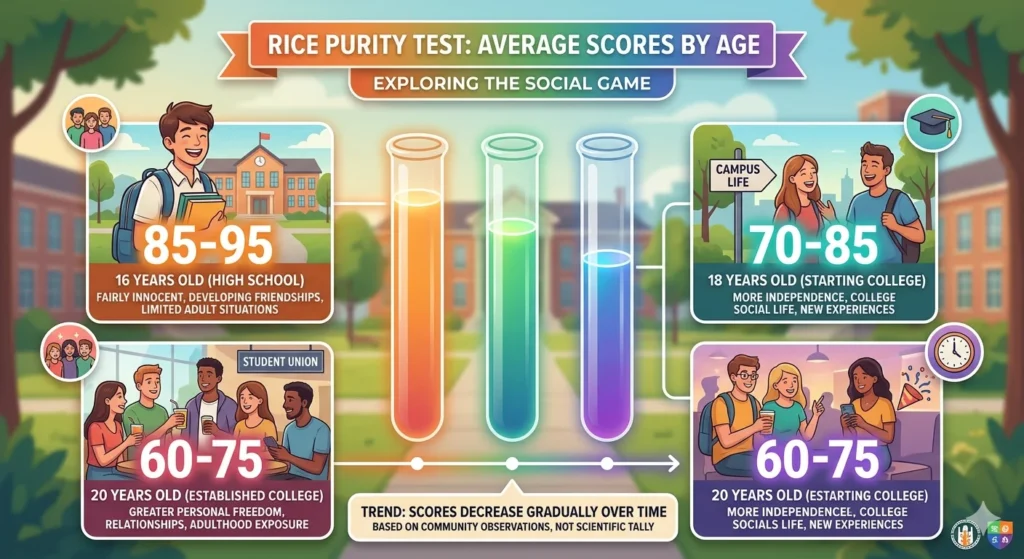
Rice purity test score meaning is a question that is often asked, which people hope to compare themselves with their friends or the online average. However, averages can greatly differ depending on:
- Age
- Country
- Culture
- Social environment
- Education level
What Does a Low Score Mean?
Lower scores may come as a shock, since they are heavily stigmatized on the Web. In fact, a low score merely means more life experiences.
If the score is lower, this can mean:
- Active social life
- Greater independence
- More relationship experience
- Adult situations = exposure to adults
The rice purity test score meaning at low figures, should never be interpreted as negative. There are various ways that people evolve, make decisions, and develop in their environments.
A common misconception about the rice purity test score meaning is that lower scores equate to confidence/popularity. This is not always the case. Individuals with low scores may even have negative feelings about some experiences, and others may have feelings of complete comfort.
What makes people obsessed with their scores?
Psychology and social comparison are the reasons for the popularity of the Rice Purity Test. It’s human nature to make comparisons to help them understand their social place.
People often:
- Share scores with friends
- Post results online
- Compare numbers in sets
- Use scores to start a discussion
This is probably why the search terms “purity test score meaning” and “rice purity test scores meaning” are still trending on social media.
The test also elicits emotional responses, as it deals with identity. A person may feel:
- Boasts a high score
- When the score is not good enough to be proud of.
- Curious about averages
- Competitive with friends
But it should be noted that this test was not created to test morality or worth.
Are there any optimum rice purity scores?
No. No perfect number exists.
The first of the many misconceptions about the rice purity test score meaning is that some scores are socially better. In reality:
- A score of 95 does not make someone better.
- A score of 25 is not considered a bad score.
- People are different as a result of their different experiences.
A score is a snapshot of experiences at one time. It can evolve according to life changes.
The Test Should Not Be Taken Seriously
The Rice Purity Test is not a psychological evaluation tool, they’re just a trend, social activity, and fun activity to do on the internet.
It does NOT measure:
- Emotional intelligence
- Kindness
- Success
- Relationship quality
- Morality
When people begin to shame or hold themselves in higher esteem based on the scores, the meaning of the rice purity test becomes problematic. It’s better to think of the test as:
- A reflection of experiences
- This is a great conversation starter!
- A playful and meaningful social experience
- A network of cultural traditions. A trend on the internet that is cultural.
Final Thoughts
Ultimately, the rice purity test score meaning is not nearly as significant as the experience, lessons, and personal growth that occurs in the number itself. Some people tread carefully, some explore more freely, and many somewhere in between. All of these are not a given to determine the nature of a person.
The key thing to keep in mind is that your score is NOT a life rating. It’s just a whimsical way of quantifying life experiences along the way. A high or low or average score isn’t an indication of your value, it’s about timing and circumstance.
Whenever you come across someone who seems to be pressured by comparison online, keep in mind that each person’s story is distinct. Enjoy the Rice Purity Test, but don’t use it as a basis for self- or other-evaluation.
FAQs
What do they expect the normal score of a Rice Purity Test to be?
The range of scores is 50 to 80 (depending on age, lifestyle and social experiences).
Is having a low Rice Purity score bad?
No. It is not a bad score, it just means that the person has more life experiences as far as the questions on the test.
What motivates college students to go through the Rice Purity Test?
It became popular among students as a social activity where they are able to compare experiences and use it as a conversation starter.
Is it possible for your Rice Purity score to change over time?
Yes. The higher one’s score, the more experiences he or she has gained, and the more experiences he or she has gained, the lower his or her score will be.
Is the Rice Purity Test accurate?
No. It’s not a clinical mental health assessment tool, it’s an internet trend for entertainment.